
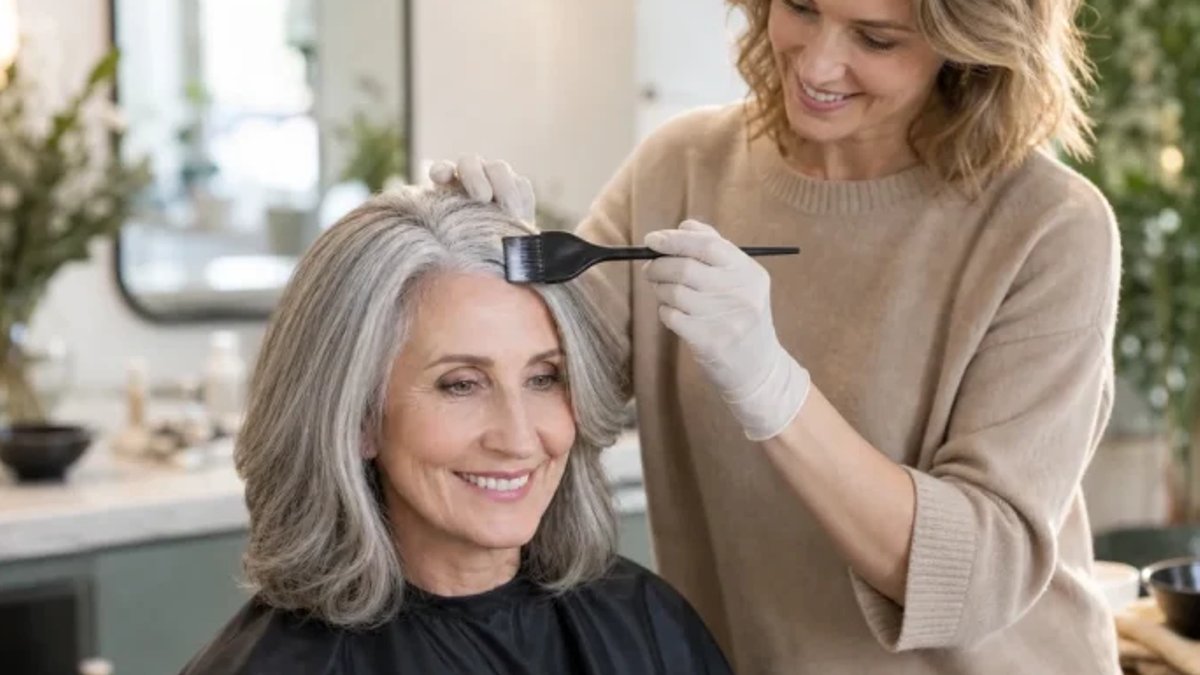
People over 60 often notice that gray hair looks dull and flat, especially in cooler months. A clear gloss applied at a salon offers a quick way to restore shine, typically starting around $30 and lasting four to six weeks.
How a Salon Gloss Works
A gloss is a demi-permanent finishing treatment with a pH between 3.5 and 4.5. The mild acidity flattens the cuticle, which is especially beneficial for gray strands that tend to be dry and porous, allowing light to reflect evenly.
The treatment does not change the hair’s color. Pigments settle only in the outer layer of the cuticle and rinse out gradually, so gray strands receive at most a light tint. Full coverage still requires permanent dye or highlights.
Current styling trends favor blending gray rather than covering it completely. Many stylists combine subtle highlights with a gloss to create soft transitions that keep the natural silver tone while adding depth.
In the salon, the effect can survive up to 25 washes, noticeably longer than at-home products. For best longevity, clients are advised to wait 24 to 48 hours before the first shampoo; washing sooner shortens the result.
Read Also: Dried Hydrangeas Create Subtle Grave Cross Tribute
Choosing Between Clear, Toned and At-Home Options
A clear gloss contains no color pigment, so it poses no risk of unwanted shade changes. On very light gray it delivers maximum shine, but it cannot neutralize any yellowing that may appear over time.
Toned silver gloss adds violet pigment to counteract yellow tones. Because violet sits opposite yellow on the color wheel, it can cancel warmth, yet porous white-gray hair may absorb the pigment unevenly, sometimes leaving a lilac sheen.
It mirrors a broader shift in grooming services toward subtle, repeatable treatments that preserve natural appearance without heavy chemical intervention.
At-home versions are available for roughly $15, but they lack the professional application that ensures even coating.
The drugstore shine mask works in three to ten minutes and provides a brief boost of softness and shine. Its pigments sit loosely on the cuticle, lasting only three to five shampoos, and can appear patchy on porous gray hair.
Read Also: Household Items Replace Pipe Cleaners in Buckeye Critter Crafts
Professional advice recommends booking the gloss together with a haircut every six to eight weeks, avoiding washing for the first 24 to 48 hours, and switching to a sulfate-free shampoo to extend the shine.
One practical detail often overlooked is timing the appointment for the morning. Applying the gloss early allows the hair to cool and settle after styling, delivering the most uniform shine when the client steps out later in the day.
What the Science Says About Gloss Performance
Because the pigment in a toned silver gloss settles only on the outer layer, it can disappear unevenly on very porous hair, sometimes leaving a faint cool shimmer. A strand test performed by a stylist helps determine whether the violet pigment will blend smoothly or produce an unwanted hue.
Most independent labs that evaluated purple shampoos found only a minority met the standards for neutralizing warmth. Testers warned that extending the contact time beyond the recommended limit could cause the pigment to linger, producing a noticeable cast on light silver hair.
Practical Guidance for Maintaining Gloss
Stylist recommendations emphasize aligning the gloss appointment with a regular haircut, ensuring the shine never fully fades before the next trim. After the treatment, delaying the first wash allows the cuticle to set, preserving the reflective surface for as long as possible.


