
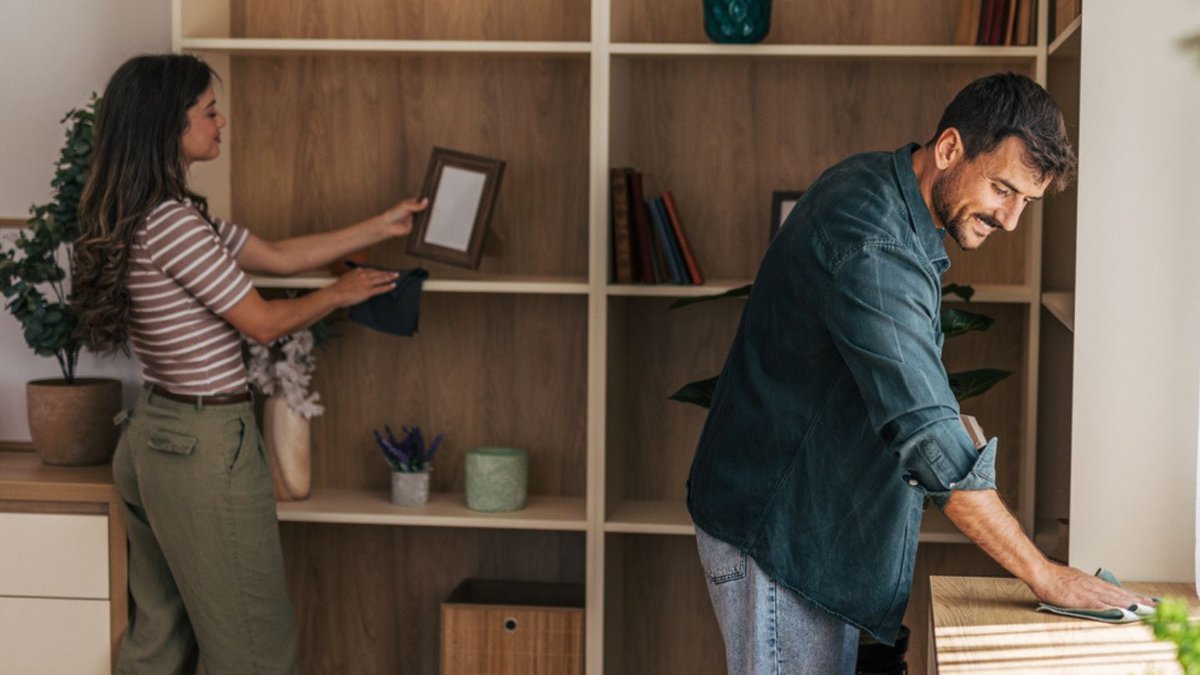
Designers and stylists often use the triangle method to style shelves, making them look balanced and not cluttered. This method involves arranging objects in a triangle shape, either horizontally or vertically, to create a visually appealing composition.
According to Amanda Hendrix of Love & Renovations, arranging three items in a triangle on a single shelf makes it look more dynamic and interesting than just two items next to each other.
Why Shelves Look Cluttered
A row of objects at the same height can read as a line, not a composition, making the bookcase look flat. When every shelf repeats the same arrangement, the eye has nowhere to rest.
Hendrix advises to “adopt white space” and notes that weight also matters. Heavy, dark, or bulky pieces placed up high can make a shelf look top-heavy, while small objects scattered low can get lost.
The Triangle Method
The triangle method fixes these problems by giving the arrangement a clear base and a clear peak. To start, take everything off the shelves and group items by size.
Read Also: Heart Risks Rise with Snow Shoveling AHA Warns
Put the heaviest pieces, such as large books or big baskets, on the lowest shelves to ground the unit. Then, taper as you go up, using smaller objects on the middle and upper shelves, with more white space around them.
Choose a peak, either centering the tallest point for a classic look or shifting it to one side for a stair-step effect. Tiffany Leigh suggests grouping items in odd numbers, such as threes or fives, on each shelf, as they are more appealing and memorable than even-numbered groupings.
Additional Tips
To add visual interest, zigzag from shelf to shelf, avoiding repetition of the same vignette directly above or below. For a shelf packed with books, repeat a material or color, such as woven baskets or pottery, at points that form a triangle across the unit.
Hendrix notes that the odd-number idea is a guideline, not a law, and that a pair of matching lamps or bookends can still look right, especially on a symmetrical built-in. She also suggests stepping back and photographing the shelves to spot imbalances in scale and color.


