
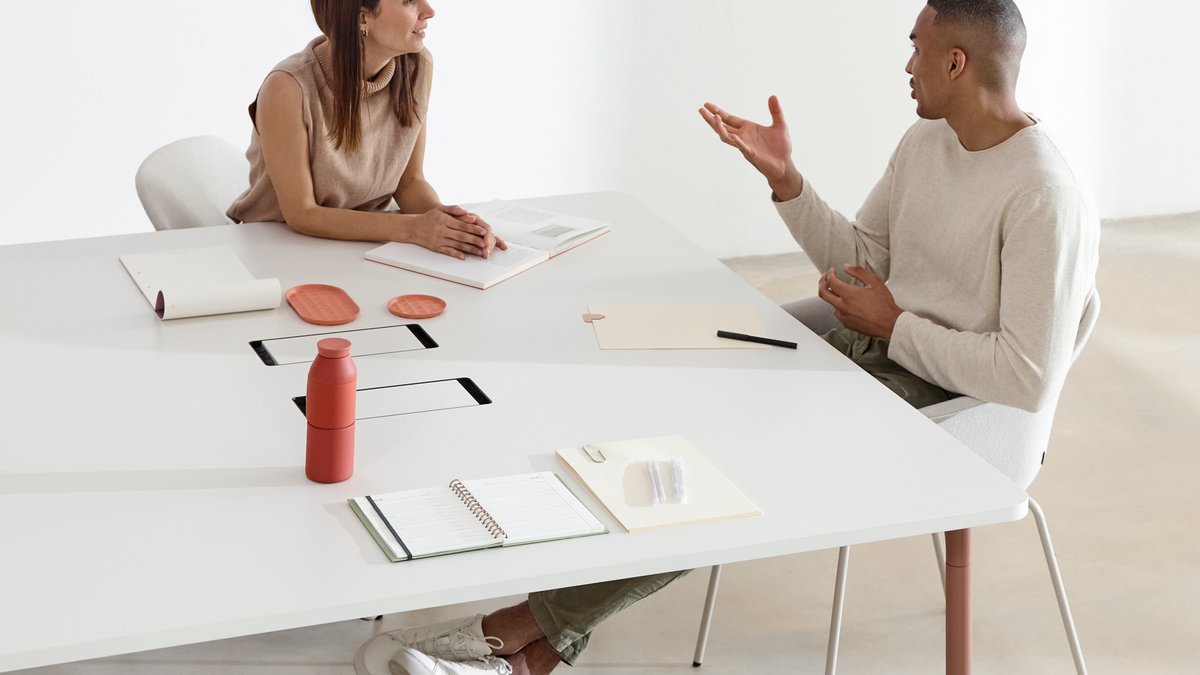
Italian designers Michele Menescardi and Cristian Gori have launched TRAYY, a modular table system designed to balance collaboration and individual focus in modern workspaces. The project emerged from a shared observation that designers could not collaborate as fluidly as musicians composing a score, prompting them to devise a flexible, evolving system for offices and educational settings.
TRAYY’s core idea is simplicity with adaptability. The system uses just two or three structural components—die-cast aluminum joints and interchangeable legs—to create tables in nearly any configuration. Whether as solo workstations, collaborative benches for up to four people, or meeting tables, the setup can shift without sacrificing stability.
The aluminum joints, developed with Actiu’s technical team, serve as the system’s backbone, enabling modularity while keeping production straightforward.
The technical challenge centered on those joints. “The major challenge of the project was the technical development of the die-cast aluminium joint,” says Menescardi. The result resists wear, supports heavy use, and can be expanded with accessories such as integrated lighting, whiteboards, or planters. Finishes range from melamine laminates to custom timber or steel powder-coated leg frames, letting users match the tables to their space’s aesthetic.
Unlike fixed furniture, TRAYY avoids the rigidity of traditional office layouts. It responds to real-time needs, teams can rearrange for brainstorming one moment, then split into focused workstations the next.
Read Also: Colour plays key role in office wellbeing
The designers drew inspiration from how musicians rearrange instruments or stands to suit a performance, applying that same flexibility to desk setups.
Gori highlighted the system’s efficiency: “With only two or three structural elements, it is possible to create a wide variety of tables and configurations.” This modularity isn’t just practical; it creates a visual identity. The clean lines of the aluminum joints and the choice of materials give TRAYY an industrial look that works in corporate offices and classrooms alike. Its durability also makes it a long-term investment, reducing the need for frequent replacements.
Accessories extend versatility. Users can add small storage containers or plant holders to tailor workspaces. The melamine finishes resist scratches and stains, while the powder-coated leg frames offer durability. The design prioritizes ease of use.
The launch follows years of collaboration between the two designers, though this was their first joint project. Their shared background in industrial design shaped TRAYY’s focus on solving a persistent problem: how to design for both collaboration and concentration in the same space.


