
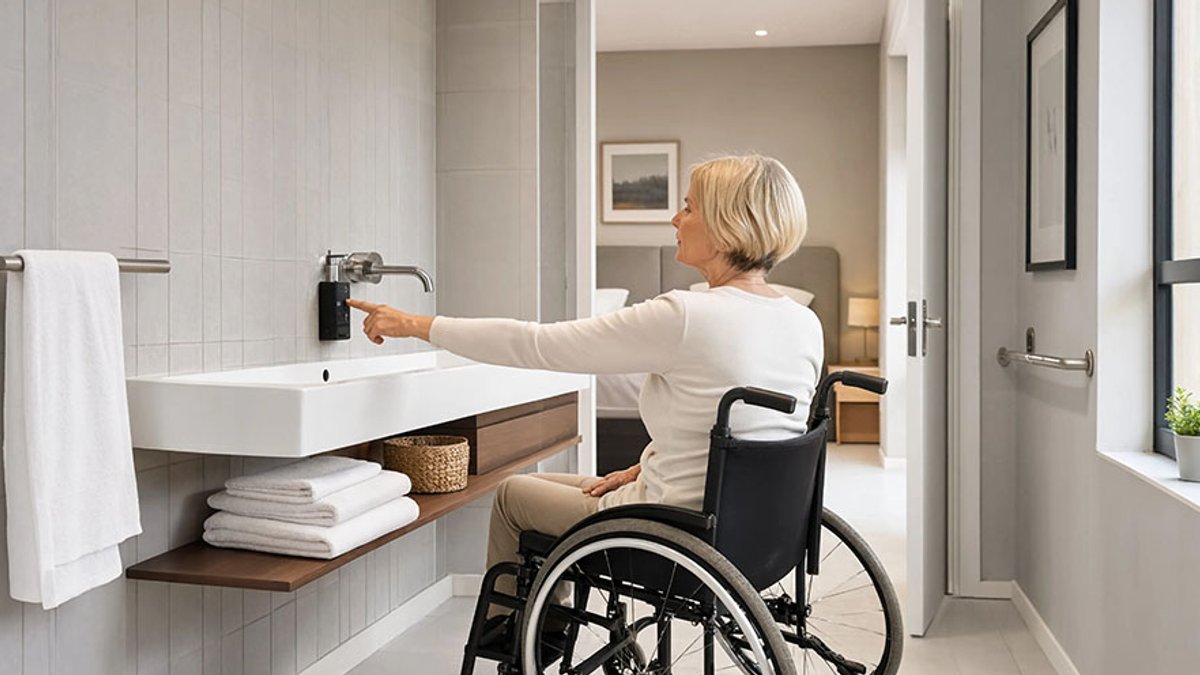
Accessible bathroom design has become a standard consideration in residential and commercial projects. Safety, function, and modern aesthetics now work together rather than being treated as separate concerns.
Grab bars get a design upgrade
The grab bar, once seen only in hospitals and fast-food restrooms, has been transformed. Newer versions feature sleek curves, stronger anchoring, and added functions. Rather than appearing as a separate fixture, they often blend with handshower holders or sliding mechanisms.
These systems let users of different heights adjust the handshower while keeping the textured grip needed for stability. They support up to 250 pounds and include larger levers, making them easier to use for people with limited strength or dexterity.
The change moves accessibility from a clinical requirement to an integrated part of design.
Related: Refin Studio Opens in Paris
Temperature control and safety take center stage
Scalding remains a serious risk in showers, particularly for older adults or those with reduced sensitivity. Local building codes determine the type of valve required—some demand pressure-balance valves, while others require thermostatic or combined systems. Each prevents sudden temperature changes if another water source, like a toilet, is used elsewhere in the building.
Internal safety features, such as balancing spools or thermostatic elements, keep the water temperature within a few degrees of the setting. Some valves also include a temperature limiter, allowing installers to set a maximum hot water mix to meet codes and user comfort.
Bélanger’s 100VSR and 300VSR series valves provide flexibility. Both allow interchangeable cartridges—pressure-balanced or combined thermostatic—so builders can install the valve body early and add the trim kit later.
This approach goes beyond meeting regulations. It addresses real-world use, where a sudden burst of hot water can turn a routine shower into a danger.
Related: Solar panels reshape home design trends
Controls that work for everyone
The exterior trim of a shower system shapes the user experience. Lever handles on mixers and diverters must follow ADA guidelines, requiring no more than 22.2 Newtons of force to operate. The same applies to lavatory faucets, whether single-hole, centerset, or widespread models.
Accessibility no longer means sacrificing style. The move toward integrated, easy-to-use controls demonstrates how the industry has progressed from obvious adaptations to fixtures that fit naturally into a bathroom’s design.
Challenges remain. Not every project prioritizes these details, and cost can still be an obstacle. Yet the progress is clear: accessible design no longer requires compromise. It creates spaces that serve everyone without standing out as specialized solutions.
The most effective designs are those that go unnoticed—until they’re needed.


